On-device reactions
Oneira's expressive reactions run on the device, so its face can respond without relying on a cloud request.
See how reactions workMaker guide / the finished build
Searching for an ESP32 AI companion? Oneira ships as an ESP32-S3 pocket companion with hardware buses, Developer Mode, and browser firmware updates over USB.
Product status
Working today means the expressive face has been demonstrated on a real Oneira device.
Connected beta features require the Oneira app, internet access, a compatible service, and permissions you approve. They can change and may not work with every service.
The short answer
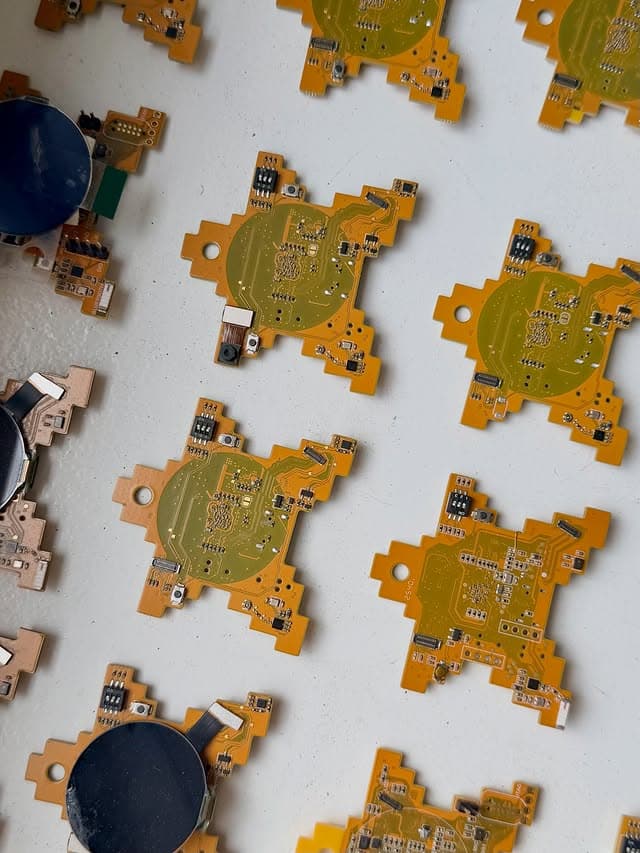
Oneira Dream Big+
Small enough to look playful. Built with a dual AI chip, OLED screen, and 1K camera, plus optional connected experiences you control.
Each $80 Founding Unit includes one Oneira device with a dual AI chip, OLED screen, and 1K camera, plus the selected color and included eye set. Only the final 1K camera module may change before fulfillment. Optional connected services, separate accounts, usage, and third-party fees are not included.
Oneira's expressive reactions run on the device, so its face can respond without relying on a cloud request.
See how reactions workThe working prototype includes a dual AI chip, OLED screen, and 1K camera. The dual AI chip, OLED screen, and 1K camera are included in the $80 Founding Unit; only the final 1K camera module may change before fulfillment.
See included hardwareOptional compatible connected services can extend Oneira when you choose. Setup, permissions, internet access, service terms, accounts, usage, and fees remain separate. Connected experiences work only with compatible services the owner deliberately configures. Oneira does not connect automatically to every service.
See compatible connectionsCompatible connected tools are optional and owner-configured. Nothing is preconfigured, and universal compatibility is not promised.
See connected featuresThe 1K camera supports deliberate, owner-triggered experiences. Optional Dream creation can transform a photo when the owner chooses it.
Open Oneira CreateOptional helper experiences have narrow, visible limits. Broader research, coding, and workspace actions remain in development.
Understand the agent pathThe search
Search for an ESP32 AI companion and the results are projects, not products: conversational companions wired together on devboards, MCP-over-MQTT experiments, and ESP32-S3 voice assistants documented step by step. The scene is active because the chip family is a natural fit for small AI hardware.
Those builds deserve respect — they prove what the platform can do. They also come with the standing bill of any DIY project: sourcing parts, printing an enclosure, managing power, and maintaining firmware that nobody else will update for you.
The shipped option
Oneira's public firmware manifest — served at /firmware/oneira/manifest.json — lists chipFamily ESP32-S3, and its browser-based updater flashes the device over USB. That makes Oneira a shipped ESP32-S3 AI companion rather than a parts list, with firmware currently at 0.8.5 and installed from a browser tab.
Around the chip sits finished hardware: a round 1.43-inch 466 × 466 AMOLED, six-axis motion reactions that run on-device with no app or internet, USB-C charging, and a star-shaped body in eight Drop 01 finishes at $139 each.
Chip context
Espressif positions the ESP32-S3 for AIoT work: a dual-core Xtensa LX7 microcontroller running up to 240 MHz, vector instructions that accelerate neural-network workloads, Bluetooth 5 (LE), and 45 programmable GPIOs on the chip family.
Those are chip-family statements from Espressif, not Oneira specifications. Oneira's own exposed pin count and electrical limits are not published, and its shipped wireless is Bluetooth LE plus Oneira-to-Oneira — plan projects around published facts.
Still yours to extend
Choosing the finished product does not end the tinkering. Oneira ships hardware tools on GPIO, I2C, SPI, and UART, so the buses a maker's bench already speaks remain reachable from the pocket device.
Developer Mode and community apps ship as well, and firmware updates stay a browser-and-USB ritual rather than a toolchain install. The DIY scene's spirit survives the unboxing; the enclosure work does not have to.
Sources and scope
This independent comparison is not sponsored or endorsed by the compared company. Product names and trademarks belong to their respective owners.
Questions, answered
Yes. Oneira's public firmware manifest, served at /firmware/oneira/manifest.json, lists chipFamily ESP32-S3, and the browser-based updater flashes firmware over USB.
Build one if the build itself is the hobby — the tutorial scene is good. Buy Oneira if you want the finished device and still want GPIO, I2C, SPI, UART, and Developer Mode to tinker with.
Not published. The 45-GPIO figure describes Espressif's chip family, not Oneira's exposed pins; check the current documentation before designing around a specific pin count, voltage, or current limit.
Oneira's published wireless capabilities are Bluetooth LE and Oneira-to-Oneira. No Wi-Fi feature is claimed here.
No Oneira subscription is required for the core product. Parts for your own bench projects and any third-party services you connect remain your own purchases.
Oneira / current availability
500 Drop 01 units remain across 5 currently available colors. Availability is confirmed when secure checkout begins.
Preorder a Founding Unit · $80